
Table of Contents
ACID in Programming: A Complete Guide to Database Transactions with Practical Implementation Examples
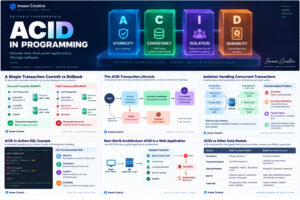
Modern applications constantly read, create, update, and delete data. A banking application transfers money between accounts. An e-commerce platform creates orders and updates inventory. A learning platform records payments and enrolls students. A marketplace may move funds into escrow while simultaneously creating transaction records.
In all these situations, one question becomes extremely important:
What happens if something goes wrong halfway through the operation?
Imagine an application transferring ₦50,000 from one wallet to another. The system successfully deducts ₦50,000 from the sender, but the server crashes before adding the money to the receiver.
You now have a serious problem.
The sender has lost ₦50,000, but the receiver never received it.
This is exactly the kind of problem that ACID transactions are designed to prevent.
ACID stands for:
A — Atomicity
C — Consistency
I — Isolation
D — Durability
Together, these principles provide a foundation for reliable database transactions, especially when an application performs several related operations that must behave as one logical unit.
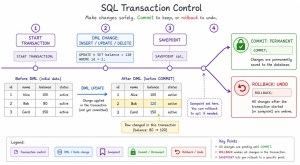
What Is a Database Transaction?
Before understanding ACID, we need to understand a transaction.
A database transaction is a collection of one or more database operations that are treated as a single logical operation.
Consider a simple money transfer.
We have two users:
Isaiah Wallet: ₦100,000
David Wallet:  ₦40,000
Isaiah wants to transfer:
₦20,000
to David.
The application needs to perform at least two operations:
1. Deduct ₦20,000 from Isaiah
2. Add ₦20,000 to David
After the transaction:
Isaiah Wallet: ₦80,000
David Wallet:  ₦60,000
Although these are two separate database updates, logically they represent one operation: transferring ₦20,000.
We therefore want the database to treat them as one transaction.
Conceptually:
BEGIN;

UPDATE accounts
SET balance = balance - 20000
WHERE id = 1;

UPDATE accounts
SET balance = balance + 20000
WHERE id = 2;

COMMIT;
If everything succeeds, COMMIT makes the changes permanent.
If something fails, we can execute:
ROLLBACK;
and undo the transaction.
This simple concept is at the heart of ACID.
READ ALSO: Samsung Galaxy S26 Ultra: What’s New and Is It Worth Buying?
Understanding the Four ACID Properties
1. Atomicity — Everything Succeeds, or Nothing Does
Atomicity means that all operations belonging to a transaction are treated as one unit.
Either:
ALL operations succeed
or:
NONE of them take effect.
There should not be a half-completed transaction.
Consider our transfer again.
Isaiah → ₦20,000 → David
The application performs:
Deduct ₦20,000 from Isaiah
Add ₦20,000 to David
Without atomicity, this could happen:
Isaiah before: ₦100,000

Deduction succeeds.

Isaiah after: ₦80,000

SERVER ERROR!

David remains: ₦40,000
The money has effectively disappeared from the application’s records.
With an atomic transaction, the database can roll back the earlier operation when the complete transaction cannot be successfully completed.
The result becomes:
Isaiah: ₦100,000
David:  ₦40,000
instead of leaving the system halfway through the transfer.
ACID in Programming: A Complete Guide to Database Transactions with Practical Implementation Examples
SQL Example
START TRANSACTION;

UPDATE accounts
SET balance = balance - 20000
WHERE id = 1;

UPDATE accounts
SET balance = balance + 20000
WHERE id = 2;

COMMIT;
If an error occurs:
ROLLBACK;
The transaction is cancelled.
Atomicity can therefore be summarized as:
Complete the whole transaction or cancel the whole transaction.
2. Consistency — Data Must Remain Valid
Consistency means that a transaction should move the database from one valid state to another valid state while preserving the application’s required rules and invariants.
Suppose our wallet application has this rule:
A wallet balance must never be negative.
A user currently has:
₦10,000
but attempts to transfer:
₦50,000
The system should not blindly execute:
UPDATE accounts
SET balance = balance - 50000
WHERE id = 1;
because the result would be:
-₦40,000
if negative balances are not allowed.
The application and database should enforce the business rule.
For example:
balance >= transfer amount
before completing the transaction.
Databases can also enforce certain consistency rules through mechanisms such as:
PRIMARY KEY
FOREIGN KEY
UNIQUE
NOT NULL
CHECK constraints
For example:
CREATE TABLE accounts (
    id BIGINT PRIMARY KEY,
    owner_name VARCHAR(100) NOT NULL,
    balance DECIMAL(15,2) NOT NULL,
    CHECK (balance >= 0)
);
The CHECK constraint helps prevent an invalid negative balance from being stored.
But consistency is broader than database constraints alone. Your application still has to correctly define and enforce its business rules.
READ ALSO: iPhone Duo vs Samsung Galaxy Z Fold8: Specifications Comparison Before You Buy
3. Isolation — Transactions Should Not Interfere Incorrectly
Real applications rarely process one request at a time.
Hundreds or thousands of users might be interacting with a system simultaneously.
Imagine an account containing:
₦100,000
Two requests arrive almost simultaneously.
Transaction A: withdraw ₦80,000
Transaction B: withdraw ₦70,000
If both operations independently read:
Balance = ₦100,000
both could conclude that sufficient funds are available.
That can create a race condition.
Isolation controls how concurrent transactions interact with each other.
Ideally, transactions behave as though they were executed safely in an appropriate order rather than exposing partially completed operations to one another.
This becomes especially important in systems involving:
wallet balances
inventory
ticket availability
order processing
financial ledgers
escrow
reservations
accounting
ACID in Programming: A Complete Guide to Database Transactions with Practical Implementation Examples

Transaction Isolation Levels
SQL databases commonly expose multiple isolation levels.
Typical levels include:
READ UNCOMMITTED
READ COMMITTED
REPEATABLE READ
SERIALIZABLE
They provide different trade-offs between concurrency and guarantees.
READ UNCOMMITTED
This is generally the weakest level.
A transaction may potentially observe data modified by another transaction before that transaction has committed, depending on the database implementation.
This creates the possibility of a dirty read.
READ COMMITTED
A transaction sees committed data rather than another transaction’s uncommitted modifications.
PostgreSQL, for example, uses Read Committed as its default isolation level.
However, two queries inside the same transaction can potentially observe different committed states when other transactions commit between those queries.
REPEATABLE READ
Repeatable Read provides stronger guarantees.
The goal is that data observed within a transaction remains stable according to the database’s isolation semantics.
Implementation details differ among database systems, so developers should check the behavior of the specific database they are using.
SERIALIZABLE
Serializable provides the strongest standard SQL isolation level.
Concurrent transactions are handled so that the final effect is equivalent to some serial execution in which those transactions ran one after another.
This provides strong guarantees but can introduce additional contention or transaction retries.
That means stronger isolation is not automatically the correct setting for every operation.
The isolation level should match the application’s correctness requirements.
4. Durability — Committed Data Should Survive Failures
Suppose our transfer succeeds.
The database responds:
Transaction successful.
Then immediately afterward:
POWER FAILURE
When the server restarts, should the transaction disappear?
No.
Once a transaction has been successfully committed, durability means its effects are intended to persist despite failures such as process or system crashes, subject to the database’s durability configuration and underlying storage guarantees.
Database engines accomplish this using mechanisms such as transaction logs and recovery systems.
For example, PostgreSQL uses Write-Ahead Logging (WAL), while MySQL InnoDB uses logging and recovery mechanisms to provide transactional durability.
Conceptually:
Transaction
     ↓
Database log
     ↓
COMMIT
     ↓
Persistent storage
If the database crashes, its recovery mechanisms can use the recorded information to restore the committed state.
READ ALSO: iPhone Duo Explained: Apple’s First Foldable iPhone, Price and Release Date
ACID in One Practical Example
Imagine an online marketplace.
A customer purchases a laptop for:
₦850,000
Several things need to happen:
1. Verify buyer balance
2. Deduct ₦850,000
3. Reserve the laptop
4. Create an order
5. Record the transaction
6. Move funds into escrow
Suppose operation five fails.
Without proper transactional design, the system could contain:
Buyer charged: YES
Laptop reserved: YES
Order created: YES
Transaction record: NO
Escrow funded: NO
The application is now inconsistent.
With an appropriate database transaction, the core database changes can be grouped:
BEGIN TRANSACTION

Verify balance

Deduct money

Reserve product

Create order

Create transaction record

Create escrow record

COMMIT
If one required database operation fails:
ROLLBACK
The database returns to its previous valid state.
That is ACID working as part of application architecture rather than simply being a definition developers memorize.
ACID in Programming: A Complete Guide to Database Transactions with Practical Implementation Examples
Implementing ACID with MySQL
MySQL’s InnoDB storage engine provides transactional capabilities including commit, rollback, locking, and crash recovery.
Consider these tables:
CREATE TABLE wallets (
    id BIGINT PRIMARY KEY AUTO_INCREMENT,
    user_id BIGINT NOT NULL,
    balance DECIMAL(15,2) NOT NULL DEFAULT 0,
    CHECK (balance >= 0)
);

CREATE TABLE transactions (
    id BIGINT PRIMARY KEY AUTO_INCREMENT,
    sender_id BIGINT NOT NULL,
    receiver_id BIGINT NOT NULL,
    amount DECIMAL(15,2) NOT NULL,
    status VARCHAR(20) NOT NULL,
    created_at TIMESTAMP DEFAULT CURRENT_TIMESTAMP
);
Now we can create a transfer.
START TRANSACTION;

UPDATE wallets
SET balance = balance - 20000
WHERE user_id = 1
  AND balance >= 20000;

UPDATE wallets
SET balance = balance + 20000
WHERE user_id = 2;

INSERT INTO transactions (
    sender_id,
    receiver_id,
    amount,
    status
)
VALUES (
    1,
    2,
    20000,
    'completed'
);

COMMIT;
If an error occurs before the commit:
ROLLBACK;
But production code needs another important check.
The first update might affect zero rows because the sender does not have enough money.
Your application should therefore verify that the expected row was actually updated before proceeding.
A Safer SQL Approach
For operations that may receive concurrent requests, locking the relevant records can be necessary.
For example:
START TRANSACTION;

SELECT id, balance
FROM wallets
WHERE user_id = 1
FOR UPDATE;
The application then checks:
Is balance >= 20000?
If not:
ROLLBACK;
Otherwise:
UPDATE wallets
SET balance = balance - 20000
WHERE user_id = 1;

UPDATE wallets
SET balance = balance + 20000
WHERE user_id = 2;

INSERT INTO transactions (
    sender_id,
    receiver_id,
    amount,
    status
)
VALUES (
    1,
    2,
    20000,
    'completed'
);

COMMIT;
FOR UPDATE is useful when the application needs to prevent conflicting transactions from simultaneously modifying selected records while the transaction is active.
Implementing ACID Transactions in Laravel
Since Laravel applications frequently use MySQL or PostgreSQL, Laravel’s database transaction API provides a clean way of grouping related database operations.
A basic example is:
use Illuminate\Support\Facades\DB;

DB::transaction(function () {

    // Database operations

});
If an exception occurs inside the transaction callback, Laravel can roll back the transaction.
If the callback completes successfully, the transaction can be committed.
ACID in Programming: A Complete Guide to Database Transactions with Practical Implementation Examples
Laravel Wallet Transfer Example
Consider a wallet transfer service.
use App\Models\Wallet;
use App\Models\Transaction;
use Illuminate\Support\Facades\DB;
use Exception;

class WalletService
{
    public function transfer(
        int $senderId,
        int $receiverId,
        float $amount
    ) {
        return DB::transaction(function () use (
            $senderId,
            $receiverId,
            $amount
        ) {

            $sender = Wallet::where('user_id', $senderId)
                ->lockForUpdate()
                ->firstOrFail();

            $receiver = Wallet::where('user_id', $receiverId)
                ->lockForUpdate()
                ->firstOrFail();

            if ($amount <= 0) {
                throw new Exception(
                    'Transfer amount must be greater than zero.'
                );
            }

            if ($sender->balance < $amount) {
                throw new Exception(
                    'Insufficient balance.'
                );
            }

            $sender->decrement('balance', $amount);

            $receiver->increment('balance', $amount);

            $transaction = Transaction::create([
                'sender_id'   => $senderId,
                'receiver_id' => $receiverId,
                'amount'      => $amount,
                'status'      => 'completed',
            ]);

            return $transaction;
        });
    }
}
Several important things happen here.
First:
DB::transaction(...)
creates the transaction boundary.
Second:
lockForUpdate()
locks the selected records for conflicting updates until the transaction finishes.
Third, exceptions prevent the transaction from completing successfully.
For example:
if ($sender->balance < $amount) {
    throw new Exception('Insufficient balance.');
}
The transfer stops instead of allowing the wallet to enter an invalid state.
Manual Transactions in Laravel
Laravel also allows explicit control.
DB::beginTransaction();

try {

    // Perform database operations

    DB::commit();

} catch (\Throwable $e) {

    DB::rollBack();

    throw $e;
}
This is useful when transaction handling requires more explicit control.
However, for many operations:
DB::transaction(function () {
    //
});
provides cleaner code.
Implementing ACID with Java and Spring Boot
Spring Boot provides powerful transaction management through Spring’s transaction infrastructure.
A common implementation uses:
@Transactional
For example:
@Service
public class WalletService {

    private final WalletRepository walletRepository;
    private final TransactionRepository transactionRepository;

    public WalletService(
            WalletRepository walletRepository,
            TransactionRepository transactionRepository) {

        this.walletRepository = walletRepository;
        this.transactionRepository = transactionRepository;
    }

    @Transactional
    public void transfer(
            Long senderId,
            Long receiverId,
            BigDecimal amount) {

        Wallet sender = walletRepository
                .findById(senderId)
                .orElseThrow();

        Wallet receiver = walletRepository
                .findById(receiverId)
                .orElseThrow();

        if (amount.compareTo(BigDecimal.ZERO) <= 0) {
            throw new IllegalArgumentException(
                    "Amount must be greater than zero"
            );
        }

        if (sender.getBalance().compareTo(amount) < 0) {
            throw new IllegalStateException(
                    "Insufficient balance"
            );
        }

        sender.setBalance(
                sender.getBalance().subtract(amount)
        );

        receiver.setBalance(
                receiver.getBalance().add(amount)
        );

        walletRepository.save(sender);
        walletRepository.save(receiver);

        Transaction transaction = new Transaction();

        transaction.setSenderId(senderId);
        transaction.setReceiverId(receiverId);
        transaction.setAmount(amount);
        transaction.setStatus("COMPLETED");

        transactionRepository.save(transaction);
    }
}
@Transactional establishes a transaction around the operation according to Spring’s transaction configuration.
If an applicable failure causes the transaction to roll back, its database modifications are not partially committed.
For financial values in Java, notice the use of:
BigDecimal
instead of floating-point types such as:
double
because financial calculations generally require precise decimal arithmetic.
Implementing ACID in Node.js
The same principle applies in Node.js.
For example, using a database client that supports PostgreSQL transactions:
const client = await pool.connect();

try {

    await client.query('BEGIN');

    const senderResult = await client.query(
        `SELECT id, balance
         FROM wallets
         WHERE user_id = $1
         FOR UPDATE`,
        [senderId]
    );

    const receiverResult = await client.query(
        `SELECT id, balance
         FROM wallets
         WHERE user_id = $1
         FOR UPDATE`,
        [receiverId]
    );

    const sender = senderResult.rows[0];
    const receiver = receiverResult.rows[0];

    if (!sender || !receiver) {
        throw new Error('Wallet not found');
    }

    if (Number(sender.balance) < amount) {
        throw new Error('Insufficient balance');
    }

    await client.query(
        `UPDATE wallets
         SET balance = balance - $1
         WHERE user_id = $2`,
        [amount, senderId]
    );

    await client.query(
        `UPDATE wallets
         SET balance = balance + $1
         WHERE user_id = $2`,
        [amount, receiverId]
    );

    await client.query(
        `INSERT INTO transactions
         (sender_id, receiver_id, amount, status)
         VALUES ($1, $2, $3, $4)`,
        [
            senderId,
            receiverId,
            amount,
            'completed'
        ]
    );

    await client.query('COMMIT');

} catch (error) {

    await client.query('ROLLBACK');

    throw error;

} finally {

    client.release();
}
Notice the same pattern again:
BEGIN
   ↓
READ/LOCK
   ↓
VALIDATE
   ↓
UPDATE
   ↓
INSERT
   ↓
COMMIT
If anything fails:
ROLLBACK
The programming language changes, but the transactional principle remains the same.
The ACID Transaction Lifecycle
A useful way to visualize the complete process is:
                REQUEST
                   │
                   ▼
          BEGIN TRANSACTION
                   │
                   ▼
            READ REQUIRED DATA
                   │
                   ▼
             LOCK IF NEEDED
                   │
                   ▼
          VALIDATE BUSINESS RULES
                   │
                   ▼
          PERFORM DATABASE WRITES
                   │
                   ▼
          DID EVERYTHING SUCCEED?
             /             \
           YES              NO
            │                │
            ▼                ▼
         COMMIT           ROLLBACK
            │                │
            ▼                ▼
         SUCCESS            ERROR
This pattern appears throughout production software.
Example: ACID in an E-Commerce Checkout
ACID is not limited to financial transfers.
Imagine an online store.
A customer purchases the last available laptop.
The system needs to:
Create order
Reduce stock
Create payment record
Create order items
Record inventory movement
These database operations are closely related.
A simplified transaction could look like:
BEGIN;

SELECT stock
FROM products
WHERE id = 501
FOR UPDATE;

UPDATE products
SET stock = stock - 1
WHERE id = 501
AND stock > 0;

INSERT INTO orders (
    user_id,
    total,
    status
)
VALUES (
    10,
    850000,
    'paid'
);

INSERT INTO order_items (
    order_id,
    product_id,
    quantity,
    price
)
VALUES (
    1001,
    501,
    1,
    850000
);

COMMIT;
If an essential database operation fails:
ROLLBACK;
This prevents situations where inventory decreases, but the corresponding order is never properly created.
READ ALSO: iPhone Duo Explained: Apple’s First Foldable iPhone, Price and Release Date
Example: Course Enrollment
Consider an LMS.
A student purchases a course.
The application might need to:
Create payment record
Create enrollment
Generate invoice record
Update course statistics
Core related database operations can be executed transactionally:
BEGIN TRANSACTION

Create payment record

Create enrollment

Create invoice

Update required database state

COMMIT
If the enrollment operation fails:
ROLLBACK
This can prevent a state where the local database says the payment operation completed but the expected enrollment record was never created.
There is, however, an important architectural complication when external payment providers are involved, which we will discuss shortly.
ACID in Programming: A Complete Guide to Database Transactions with Practical Implementation Examples
Common Problems ACID Helps Prevent
Partial Updates
One operation succeeds while another fails.
Example:
Money deducted
Receiver not credited
Atomic transactions address this.
Dirty Reads
One transaction sees another transaction’s uncommitted data.
Appropriate isolation prevents this according to the database’s isolation guarantees.
Lost Updates
Two concurrent operations modify the same information, and one change unintentionally overwrites or invalidates another.
Proper locking, atomic updates, optimistic concurrency control, or stronger isolation can address this depending on the use case.
Invalid Relationships
A child record references something that does not exist.
Foreign keys can help enforce relational integrity.
FOREIGN KEY (user_id)
REFERENCES users(id)
Duplicate Data
Suppose two simultaneous requests attempt to create the same payment reference.
Application checks alone may not be sufficient.
Use a database uniqueness constraint:
UNIQUE(payment_reference)
Then even under concurrent requests, the database has a final line of defense against duplicates.

ACID Does Not Replace Good Application Design
One common misconception is:
We're using an ACID database,
therefore our application cannot corrupt data.
That is not necessarily true.
A developer can still write incorrect transaction logic.
For example:
DB::transaction(function () {

    Wallet::find(1)->decrement(
        'balance',
        50000
    );

});
If the application never verifies whether the withdrawal is valid, the transaction itself cannot magically understand the business requirement.
The database can guarantee transactional behavior, but the application must still define what valid behavior means.
This is especially important for the Consistency part of ACID.
READ ALSO: Google Pixel 11 Pro and Pixel 11 Pro XL: What You Need to Know Before Buying
ACID and External APIs
This is where application architecture becomes more interesting.
Suppose your transaction does this:
1. Deduct wallet balance
2. Create order
3. Send email
4. Call shipping API
5. Call another microservice
6. Commit
A normal database transaction does not automatically make every external system part of that transaction.
For example:
BEGIN DATABASE TRANSACTION

Create order

Call shipping API → SUCCESS

Database operation fails

ROLLBACK DATABASE
The database changes might be rolled back, but the external shipping API has already received the request.
The database cannot simply execute:
ROLLBACK SHIPPING COMPANY
This leads us into distributed systems.
ACID in Programming: A Complete Guide to Database Transactions with Practical Implementation Examples
ACID in Microservices
In a monolithic application using one relational database, transactions can be relatively straightforward.
For example:
Application
     │
     ▼
Single Database
     │
     ├── Users
     ├── Wallets
     ├── Orders
     └── Transactions
A single database transaction can modify multiple related tables.
Microservices may look different:
Order Service
     │
     ▼
Order Database


Payment Service
     │
     ▼
Payment Database


Inventory Service
     │
     ▼
Inventory Database
Now a single business operation spans multiple systems.
A local ACID transaction cannot automatically roll back all independent databases and external services.
Architectures addressing this problem may use techniques such as:
Saga Pattern
Transactional Outbox
Idempotency
Event-driven architecture
Distributed transaction protocols
Compensating transactions
These techniques deserve their own detailed discussion because they solve a different layer of the reliability problem.
The Transactional Outbox Pattern
One particularly useful approach is the Transactional Outbox Pattern.
Suppose an order needs to be created and an event published.
A risky implementation is:
Create Order
     ↓
COMMIT
     ↓
Publish Event
What happens if the application crashes immediately after COMMIT?
The order exists, but the event might never be published.
Instead, store both the business change and an outbox message in the same database transaction.
BEGIN

Create Order

Create Outbox Event

COMMIT
For example:
BEGIN;

INSERT INTO orders (
    customer_id,
    total,
    status
)
VALUES (
    25,
    250000,
    'confirmed'
);

INSERT INTO outbox_events (
    event_type,
    payload,
    status
)
VALUES (
    'ORDER_CREATED',
    '{"order_id": 1001}',
    'pending'
);

COMMIT;
A separate worker processes:
outbox_events
and publishes the event.
Conceptually:
Customer
   │
   ▼
Application
   │
   ▼
┌───────────────────────┐
│ DATABASE TRANSACTION  │
│                       │
│ Create Order          │
│ Create Outbox Event   │
└───────────┬───────────┘
            │
          COMMIT
            │
            ▼
      Outbox Worker
            │
            ▼
       Message Broker
            │
            ▼
     Other Services
This creates a reliable connection between transactional database state and asynchronous messaging.
Idempotency: Another Important Companion to ACID
Imagine a mobile application sends a payment request.
The connection becomes slow.
The user taps:
PAY
again.
Now the server receives two requests.
Without protection:
Request 1 → ₦50,000
Request 2 → ₦50,000
The customer could be processed twice.
One common defense is an idempotency key.
Example request:
Idempotency-Key: payment_839291
Store it with a uniqueness constraint:
CREATE TABLE payment_requests (
    id BIGINT PRIMARY KEY,
    idempotency_key VARCHAR(100) UNIQUE,
    amount DECIMAL(15,2),
    status VARCHAR(30)
);
If the same request arrives again:
payment_839291
the application can recognize that it has already processed that logical request instead of blindly creating another transaction.
ACID protects the integrity of the database transaction.
Idempotency protects the business operation from accidental repetition.
The two concepts work extremely well together.
Pessimistic vs Optimistic Concurrency Control
There are two important strategies for managing concurrent modifications.
Pessimistic Locking
The assumption is essentially:
Another transaction may conflict,
so protect the record now.
Example:
SELECT *
FROM wallets
WHERE id = 10
FOR UPDATE;
This is useful for highly sensitive operations such as balance changes or limited inventory when conflicts must be carefully controlled.
Optimistic Concurrency
The assumption becomes:
Conflicts are uncommon.
Detect them if they happen.
A record might contain:
version = 7
The application reads the version 7 and attempts:
UPDATE products
SET stock = 19,
    version = 8
WHERE id = 10
AND version = 7;
If another transaction already changed the record, its version may now be:
8
The update affects zero rows.
The application detects the conflict and can retry or return an appropriate response.
This avoids holding a database lock throughout the entire application operation.
Database Constraints Are Your Friend
Do not depend exclusively on application code for critical invariants.
Suppose usernames must be unique.
This is not enough:
if (!User::where('username', $username)->exists()) {

    User::create(...);

}
Two requests could potentially perform the check simultaneously.
Both see:
Username available.
Both attempt insertion.
A database constraint provides stronger enforcement:
ALTER TABLE users
ADD CONSTRAINT users_username_unique
UNIQUE (username);
Now the database itself enforces the invariant.
The same principle applies to:
Email addresses
Transaction references
Order numbers
Payment references
External event IDs
Idempotency keys
READ ALSO: All you need to know about TikTok Programs
Deadlocks
Transactions introduce another concept developers should understand: deadlocks.
Imagine:
Transaction A locks Wallet 1
Transaction B locks Wallet 2
Then:
Transaction A requests Wallet 2
Transaction B requests Wallet 1
Now:
Transaction A
     ↓
waiting for Wallet 2

Transaction B
     ↓
waiting for Wallet 1
Neither can continue.
Database systems can detect deadlocks and abort one of the transactions.
Applications should therefore be designed to handle retryable transaction failures where appropriate.
A useful strategy is consistent lock ordering.
Instead of locking:
sender
then receiver
you might consistently lock records according to a deterministic rule such as ascending account ID.
This reduces opportunities for conflicting lock order.
Keep Transactions Short
Avoid doing unnecessary work while holding a database transaction open.
A poor design might be:
BEGIN

Lock wallet

Generate PDF

Send email

Call external API

Resize image

Upload file

Update wallet

COMMIT
The transaction stays open while slow external work is happening.
This can increase:
lock contention
deadlock risk
database load
request latency
connection usage
Prefer keeping the transactional portion focused.
For example:
Validate request

BEGIN

Lock necessary records

Perform required database writes

COMMIT

Dispatch asynchronous work
Then jobs such as email processing or other asynchronous work can be handled separately, provided the architecture ensures those jobs are not accidentally dispatched for transactions that ultimately fail.

When Should You Use ACID Transactions?
Transactions are especially important when several related database operations must succeed together.
Typical examples include:
Financial systems
Wallet transfers
Payments
Refunds
Escrow
Ledger entries
E-commerce
Order creation
Inventory reservation
Refund records
Coupon redemption
Learning platforms
Enrollment
Subscription activation
Certificates
Course purchases
Marketplaces
Orders
Escrow
Vendor balances
Commissions
Payout records
Booking systems
Seat reservation
Hotel availability
Appointments
Ticket allocation
Authentication and security systems
Account creation
Role assignment
Token records
Security events
Whenever the requirement sounds like:
Either all of these database changes happen, or none of them should happen.
you should immediately consider a transaction.
ACID in Programming: A Complete Guide to Database Transactions with Practical Implementation Examples
ACID Does Not Mean Every Operation Needs One Giant Transaction
Another mistake is wrapping an entire application workflow in one enormous transaction.
For example:
User registers
Send email
Generate profile image
Create analytics event
Send Slack notification
Call CRM
Upload document
Create subscription
Putting all of this inside one long-running database transaction can create unnecessary complexity and contention.
Instead, identify the operations that must be atomically consistent.
For example:
BEGIN

Create user

Create profile

Assign default role

COMMIT
Then trigger other work appropriately after the committed state exists.
Good transactional architecture is not about maximizing transaction size.
It is about choosing the correct transaction boundary.
ACID vs BASE
When discussing large distributed systems, you may also encounter the term:
BASE
commonly expanded as:
Basically Available
Soft State
Eventually Consistent
ACID emphasizes transactional guarantees around operations.
Eventually consistent distributed architectures may allow different replicas or services to temporarily observe different states before converging.
That does not mean:
ACID = good
BASE = bad
or the reverse.
They address different architectural requirements and trade-offs.
Modern systems can even combine approaches.
For example:
ACID
    ↓
Local payment database

Event-driven messaging
    ↓
Distributed services

Eventually consistent projections
    ↓
Analytics/search/cache
A system can therefore use strong local transactions for critical records while allowing other parts of the architecture to synchronize asynchronously.
READ ALSO: How to Activate Developer option in Excel
ACID and NoSQL
It is also incorrect to assume:
SQL = ACID
NoSQL = no ACID
Modern database systems vary considerably.
Some NoSQL databases provide transactional features, while the guarantees and scope of transactions differ between technologies.
The better engineering question is:
What transactional and consistency guarantees does this specific database provide for this specific operation?
rather than relying only on whether the database is classified as SQL or NoSQL.
ACID Best Practices for Production Applications
When designing transactional systems, follow a few important principles:
- Keep transactions short.
Do only the database work that must be atomic. - Use database constraints.
UseUNIQUE,FOREIGN KEY,NOT NULL, andCHECKwhere appropriate. - Use the correct isolation strategy.
Do not assume the database’s default isolation level automatically prevents every race condition. - Lock carefully.
Use mechanisms such asSELECT ... FOR UPDATEwhen the business operation requires pessimistic locking. - Expect transaction failures.
Deadlocks and serialization failures can happen. Design safe retry strategies where appropriate. - Use idempotency for repeatable requests.
This is particularly important for payment and order APIs. - Do not keep transactions open during unnecessary external API calls.
- Use precise data types.
For money, prefer database types such as:
DECIMAL(15,2)
rather than floating-point representations.
- Maintain audit records for critical operations.
- Test concurrency, not only normal requests.
An application that works perfectly with one user can still fail when 100 requests arrive simultaneously.
ACID in Programming: A Complete Guide to Database Transactions with Practical Implementation Examples
A Production-Oriented Transaction Architecture
A robust financial-style operation might look like this:
                    CLIENT
                       │
                       ▼
                 API ENDPOINT
                       │
                       ▼
             AUTHENTICATION
                       │
                       ▼
              VALIDATE REQUEST
                       │
                       ▼
            CHECK IDEMPOTENCY KEY
                       │
                       ▼
             BEGIN TRANSACTION
                       │
                       ▼
             LOCK REQUIRED ROWS
                       │
                       ▼
          VALIDATE BUSINESS RULES
                       │
                       ▼
             UPDATE BALANCES
                       │
                       ▼
             CREATE LEDGER ENTRY
                       │
                       ▼
          CREATE TRANSACTION RECORD
                       │
                       ▼
             CREATE OUTBOX EVENT
                       │
                       ▼
                    COMMIT
                       │
                       ▼
                 RETURN RESULT
                       │
                       ▼
                OUTBOX WORKER
                       │
              ┌────────┼────────┐
              ▼        ▼        ▼
            EMAIL    EVENTS   NOTIFICATION
Notice how ACID is not treated as an isolated database theory.
It becomes one part of a larger reliability architecture involving:
Transactions
Constraints
Locking
Idempotency
Audit trails
Outbox messaging
Error handling
Retries
That is much closer to how ACID matters in real software engineering.
Final Thoughts
ACID may appear to be a simple acronym taught during database lessons, but its importance becomes much clearer once you begin building systems that handle real users, concurrent requests, payments, inventory, orders, wallets, subscriptions, or other critical data.
Remember:
A — Atomicity
All required operations succeed or the transaction is rolled back.

C — Consistency
The operation preserves the rules and invariants that define valid data.

I — Isolation
Concurrent transactions interact according to defined isolation guarantees.

D — Durability
Successfully committed changes are intended to survive failures.
A developer who understands only CRUD can create records.
A developer who understands transactions can start building systems that remain correct when operations fail.
And a developer who understands transactions, concurrency, locking, idempotency, constraints, and distributed consistency can design applications that remain reliable as traffic and architectural complexity increase.
When building your next Laravel, Spring Boot, Node.js, marketplace, LMS, e-commerce, fintech, or enterprise application, don’t only ask:
“Did the query execute?”
Ask:
“What happens if the second query fails?”
“What happens if two users perform this operation at the same time?”
“What happens if the server crashes immediately after this operation?”
“What happens if the client sends the same request twice?”
Those questions are where ACID stops being database theory and starts becoming practical software engineering. Next, I will explain each term in detail with examples and use cases to help you understand better while building your next application.
Note: ACID can also be implemented in all backend languages, not just the few I gave examples with; the once i mentioned are what I use most when building for client or personal projects. You can read more on how you can apply ACID using your core language, or drop a comment and I will reply to it.
Imaew Creative/Next-Gen Tech — Technology, Software Development & Digital Innovation
At Imaew Creative, we explore programming, software architecture, emerging technologies, and practical engineering concepts to help developers understand not only how to write code, but how to design reliable systems.

Author: Zazasco
Am a professional with more than 5 years of experience in Graphic designing, Content Creation, Web/Mobile Development, Animation, Vfx, Photo/Videographer, Branding. Am so much passionate about what I do and always researching to improve myself to meet up with trends and demands, I love teaching and also open to learning new skills. For more info. About me send me a message indicating your questions and get a reply from me.


2 thoughts on “ACID in Programming: A Complete Guide to Database Transactions with Practical Implementation Examples”